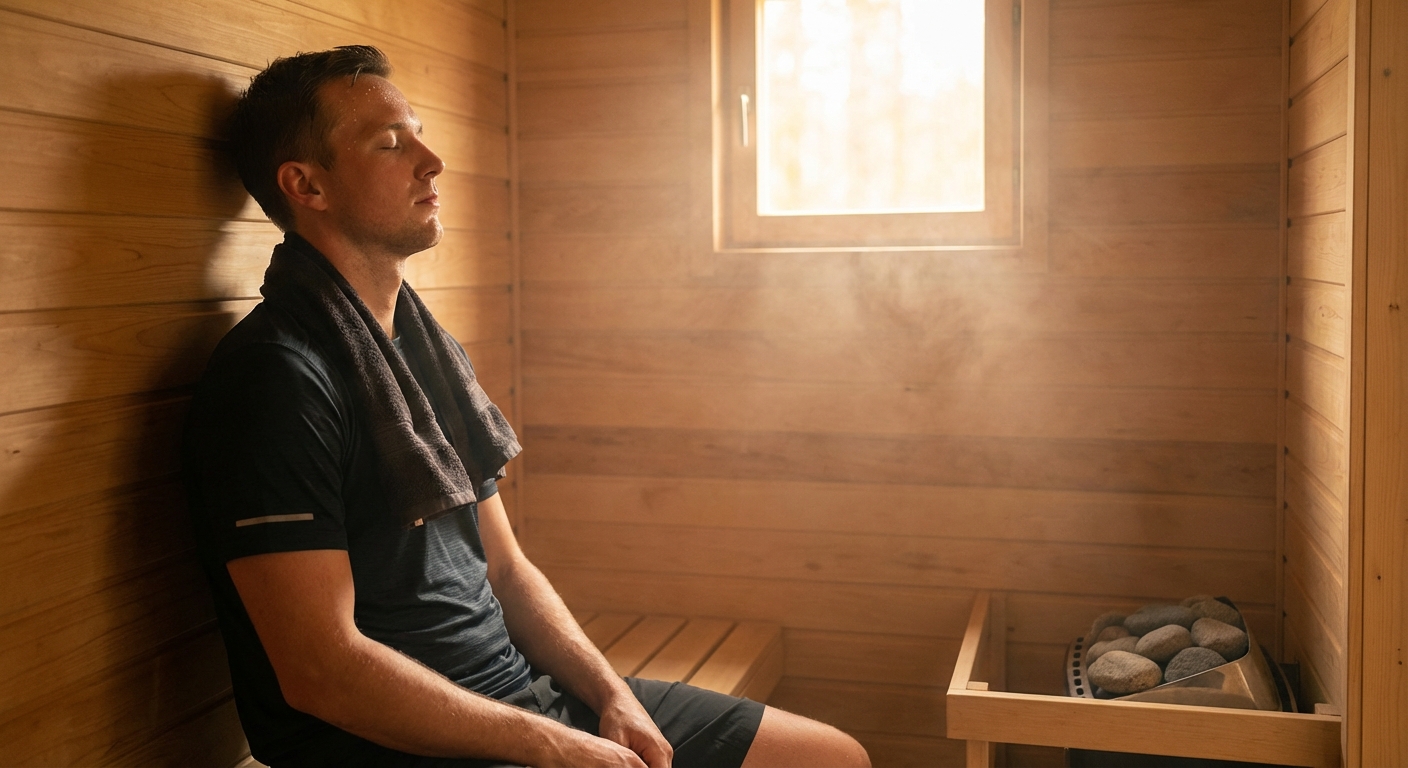
Sauna is far more than a relaxing wellness ritual. Behind those steaming sessions lie fascinating physiological processes that scientists have been researching for decades. From boosting cardiovascular health to activating protective mechanisms at the cellular level – the data is surprisingly comprehensive.
Your Body’s Physiological Response to Heat
When you enter a sauna, your body triggers a cascade of adaptive responses. Core body temperature rises by 1–2°C, triggering a chain reaction:
- Increased heart rate: The heart pumps faster to dissipate heat. Heart rate can reach 120–150 bpm – comparable to moderate exercise.
- Vasodilation: Blood vessels expand, blood pressure drops slightly, while skin blood flow increases dramatically.
- Sweat production: Up to 0.5–1 liter of fluid can be lost per sauna session – an important detoxification mechanism.
These responses are similar to those of cardiovascular training, explaining why regular sauna sessions are associated with similar health benefits as moderate endurance exercise.
Cardiovascular Health: The Evidence
The most extensive scientific data comes from Finland, where sauna culture runs deep. A longitudinal study with over 2,300 men over 20 years showed:
| Sauna Usage | Cardiovascular Mortality | All-Cause Mortality |
|---|---|---|
| 1x/week | Reference | Reference |
| 2–3x/week | -22% | -24% |
| 4–7x/week | -48% | -40% |
Source: Laukkanen et al., JAMA Internal Medicine, 2015
These results are impressive: Those who sauna 4–7 times per week nearly halve their risk for cardiovascular events. Of course, this is correlational data – the likelihood that frequent sauna users generally lead healthier lifestyles is high. Nevertheless, the association remains significant even after controlling for known risk factors.
Heat Shock Proteins and Cellular Regeneration
One of the most fascinating mechanisms is the activation of heat shock proteins (HSP). These molecular protective chaperones are produced in response to heat stress and:
- Repair damaged proteins: Misfolded or oxidized proteins are recognized and restored.
- Protect against cell damage: HSP70 shows strong anti-apoptotic (cell death inhibiting) properties.
- Improve insulin sensitivity: Increased HSP70 levels correlate with better glucose tolerance.
A study from Heidelberg University Hospital showed that two 30-minute sauna sessions per week over three months significantly increased HSP70 expression – a mechanism that also plays a role in exercise adaptation.
Sauna and HRV: What Does the Research Say?
Heart rate variability (HRV) is considered the gold standard for measuring autonomic regulation. Several studies examined the impact of sauna sessions:
Acute effect: Immediately after a sauna session, HRV briefly decreases – the body is in “stress” mode for heat regulation. However, within 30–60 minutes after the sauna session, an improvement in parasympathetic activity is typically observed.
Japanese researchers found that regular sauna sessions (5x/week for 2 weeks) led to a significant increase in SDNN (Standard Deviation of NN intervals) – a marker for improved cardiovascular adaptability.
Practical tip: Don’t measure your HRV directly after a sauna session; wait at least 30–60 minutes. The recovery effects typically show up during the rest period afterward.
Cortisol and Stress Reduction
The relationship between sauna and cortisol is more complex than often assumed. Acute sauna exposure leads to a cortisol rise – the body interprets heat as physical stress.
However, regular sauna sessions can improve cortisol diurnal rhythm: The morning cortisol peak becomes more harmonized, and the evening decline happens faster. This is particularly interesting for people with chronic stress or sleep problems.
Finnish researchers observed that after 12 weeks of regular sauna use (3x/week), there was a significant reduction in serum cortisol compared to the control group.
Sauna After Training: Useful or Counterproductive?
Whether sauna improves or impairs exercise recovery is debated. The data shows:
Potential benefits:
- Improved blood flow and nutrient supply to muscles
- Reduction of muscle soreness (DOMS) – several studies show 20–40% less muscle pain after sauna use
- Psychological recovery and stress reduction
Potential downsides:
- With excessive use (too hot, too long) muscle protein synthesis could theoretically be impaired
- Dehydration can hinder recovery
Conclusion: A short sauna session (8–15 minutes) at moderate temperature (70–80°C) after training is unproblematic for most people and can subjectively improve recovery. Intense sauna use directly before important training sessions should be avoided.
Practical Recommendations for Optimal Sauna Use
Based on the scientific literature, here are my evidence-based recommendations:
Optimal Parameters
- Temperature: 70–90°C (Finnish sauna) or 45–60°C (infrared)
- Duration: 8–15 minutes per session
- Frequency: 3–5x per week for maximum benefits
- Hydration: 300–500ml water before and after each sauna session
Contraindications
- Acute heart conditions (unstable angina, recent heart attack)
- Severe hypertension (blood pressure >180/110 mmHg)
- Pregnancy (first trimester)
- Febrile illness
The Classic Sauna Cycle
- Preparation: Shower, dry well (wet skin increases heat absorption)
- First round: 8–10 minutes at 70–80°C
- Cool down: Cold shower or plunge pool (30 seconds to 2 minutes)
- Break: 10–15 minutes at room temperature
- Second round: Optional, same procedure
- Relaxation: 20–30 minutes rest phase
Comparison: Sauna vs. Other Recovery Methods
| Method | Evidence Level | Accessibility | Time Required |
|---|---|---|---|
| Sauna | High (many cohort studies) | Medium | 1–2h |
| Cold (Cold Plunge) | Medium | Low | 5–15 min |
| Massage | Low-Medium | Medium | 30–90 min |
| Sleep | Very high | High | 7–9h |
| Active Recovery | Medium | High | 20–40 min |
The evidence for sauna is actually one of the most solid among complementary recovery methods – comparable to the evidence for sleep, but not as extensive as for active recovery.
Conclusion
Science provides compelling arguments for regular sauna sessions as part of a holistic health optimization strategy:
- Cardiovascular health: Up to 50% risk reduction for cardiovascular disease with regular use
- Cellular regeneration: Activation of heat shock proteins promotes repair processes
- Stress regulation: Long-term improved cortisol diurnal rhythm and parasympathetic activity
- Subjective well-being: Consistent reports of improved sleep quality and relaxation
The optimal “dose” is 3–5 sessions per week of 8–15 minutes each. As with all health interventions: individualization is key. Those starting out should build up slowly and pay attention to their body’s signals.
Practical FAQ
Should I use sauna after every workout?
Not necessarily. After very heavy sessions (high volume lower body, poor sleep, high stress), adding maximal heat can become too much total load. Use a flexible approach: shorter/milder sessions on hard training days, longer sessions on easier days.
Is cold immersion mandatory after sauna?
No. Cooling is optional. If your primary goal is relaxation and better sleep, aggressive post-sauna cold exposure may reduce the calming effect. Use a cooldown strategy that supports your objective.
Morning or evening sauna?
Both can work:
- Morning can feel energizing and improve daytime mood.
- Evening often supports wind-down and sleep quality.
The best choice is the time you can repeat consistently without compromising hydration, meals, and bedtime.
Can sauna help during a fat-loss phase?
Yes, as a recovery and stress-management tool. But acute weight drops after sauna are mostly fluid loss, not body-fat loss. In a calorie deficit, sauna should usually be shorter and hydration/electrolytes should be more deliberate.
Common mistakes that reduce recovery
-
Too hot, too long, too soon
- Beginners often scale intensity faster than adaptation.
-
Ignoring sodium replacement
- Heavy sweat loss without electrolytes can worsen sleep and next-day readiness.
-
Treating sauna as punishment
- Recovery is about adaptation, not exhaustion.
-
No tracking loop
- Without sleep/readiness/performance tracking, protocol quality stays guesswork.
14-day sauna onboarding plan
- Week 1: 2 sessions, 8–10 minutes each, moderate heat
- Week 2: 3 sessions, 10–12 minutes each, optional second round
- After each session: rehydrate, calm cooldown, note sleep and next-day energy
If recovery markers improve, gradually progress to 3–4 sessions weekly. If markers worsen, reduce duration first, then temperature.
Recovery scorecard (simple and useful)
Use a weekly 1–5 score for:
- sleep quality,
- morning energy,
- muscle stiffness,
- training consistency,
- stress load.
If your 4-week trend improves, your sauna protocol is likely helping. If scores flatten or drop, reduce dose and fix hydration before adding complexity.
Three real-world use cases
Case 1: Office worker + 3 strength sessions/week
Issue: high cognitive stress, difficulty winding down, fragmented sleep.
Protocol:
- 2–3 evening sauna sessions weekly,
- moderate heat,
- avoid maximal intensity,
- prioritize calm post-sauna cooldown.
Goal: nervous-system downshift and better sleep behavior.
Case 2: Endurance athlete preparing for warm conditions
Issue: poor heat tolerance and early fatigue in hot sessions/races.
Protocol:
- 3 sessions per week after easy/moderate training,
- 12–20 minutes total exposure,
- deliberate fluid + sodium replacement,
- monitor weekly readiness.
Goal: better heat adaptation and lower perceived effort in warmth.
Case 3: Fat-loss phase with low energy availability
Issue: recovery capacity is limited and stress load is already high.
Protocol:
- 1–2 shorter sessions weekly,
- avoid long sauna right after very hard sessions,
- emphasize electrolytes and meal timing,
- reduce frequency if sleep/readiness declines.
Goal: maintain recovery quality while dieting.
Progression model (6 weeks)
Week 1–2: Acclimation
- 8–10 minutes, twice weekly
Week 3–4: Consolidation
- 10–12 minutes, three times weekly
Week 5–6: Individualization
- optional second round or slight duration increase,
- only if sleep and training quality remain stable.
Rule: never increase heat, duration, and frequency at the same time. Change one variable per week.
Keep it simple to make it sustainable
Many people fail not because sauna does not work, but because their protocol is overcomplicated.
Start with four basics:
- fixed weekly slots,
- consistent default duration,
- hydration/electrolyte routine,
- next-day readiness check.
Once these basics are stable, optimization becomes easy. Without basics, “advanced recovery” becomes random.
Sources:
- Laukkanen et al., JAMA Internal Medicine, 2015
- Hussain & Cohen, Evidence-Based Complementary and Alternative Medicine, 2018
- Hannuksela & Ellahham, American Journal of Medicine, 2001
- Knechtle et al., Frontiers in Physiology, 2020
- Pilch et al., Journal of Human Kinetics, 2014