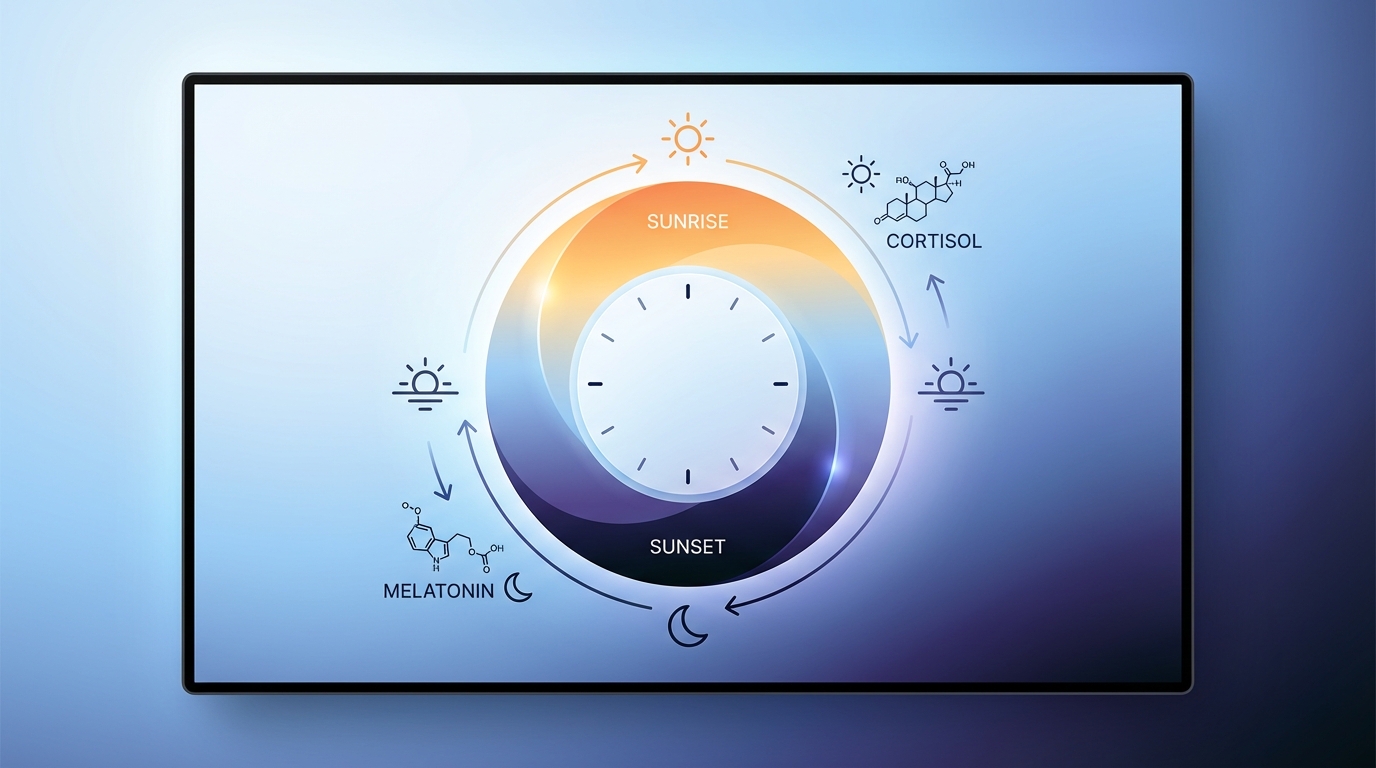
Circadian Rhythm Hacking: How to Sync Your Body with Nature
Your body has an internal clock – the circadian rhythm. This 24-hour cycle controls almost every function: sleep and wakefulness, hormone release, metabolism, and body temperature. When you optimize this internal clock, you can achieve dramatic improvements in energy, sleep quality, mental performance, and long-term health.
In this guide, you’ll learn what science knows about circadian rhythm and which practical strategies you can implement immediately.
What is the Circadian Rhythm?
The circadian rhythm is an approximately 24-hour biological cycle that runs in nearly every cell of your body. The master clock system is located in the Suprachiasmatic Nucleus (SCN) – a tiny region in the hypothalamus located directly behind the eyes that responds to light signals.
This internal timekeeper synchronizes:
- Sleep-wake cycles through melatonin and cortisol
- Body temperature (lowest at 4 AM, highest at 6 PM)
- Hormone production (growth hormone, testosterone, thyroid hormones)
- Metabolism (insulin sensitivity, fat burning)
- Cognitive performance (attention, memory, mood)
Fascinating: Even isolated people in caves without daylight show a 24-hour rhythm – the body has its own, internal clock.
The Key: Light as the Strongest Zeitgeber
Light is the dominant synchronization factor for your circadian rhythm – by a huge margin stronger than any other variable. This is due to melanopsin, a photoreceptor in your eyes that specifically responds to blue light (approx. 480 nm wavelength) and directly signals the SCN.
Morning: Bright, Bright, Bright
The first hour after waking is crucial. During this time, you need bright light (at least 10,000 lux) to:
- Activate cortisol morning peak – your natural wake-up call
- Promote melatonin suppression for clear alertness
- Start body temperature rise – you wake up
- Activate metabolism – better insulin sensitivity
Practical implementation:
- Immediately after waking: 10-30 minutes of daylight (even on cloudy days)
- Alternative: Light therapy lamp (10,000 lux) right after waking
- Avoid sunglasses during this time (your eyes need the light)
Evening: Dark, Dark, Dark
Just as important as bright light in the morning is darkness in the evening. From about 8 PM, melatonin production begins – but only if your body receives no blue light signals.
Practical implementation:
- Red light instead of white/blue light from 9 PM
- Blue filters/apps like f.lux or Night Shift on all devices
- Dimmer switches for all lights in the house
- No screens at least 30 minutes before bed
Optimal Bedtime: Understanding Chronotypes
Not everyone should go to bed at the same time. Your chronotype – your genetically determined preference for sleep and activity times – determines your optimal window.
The Four Chronotypes
| Chronotype | Characteristics | Optimal Sleep Onset |
|---|---|---|
| Bear (70%) | Synchronized with the sun, midday productivity peak | 10:30 PM - 11:30 PM |
| Wolf (15%) | Late riser, productive in the evening, hard to get up | 11:30 PM - 12:30 AM |
| Lion (10%) | Early riser, productive in the morning, tired early | 9:30 PM - 10:30 PM |
| Dolphin (10%) | Light sleeper, often nervous, irregular sleep | 11:00 PM - 12:00 AM |
Important: Your chronotype is partly genetic – don’t try to completely override it. Work with it, not against it.
Practical Circadian Rhythm Hacking: 24-Hour Optimization
6:00 - 8:00 AM: The Start
- Wake up immediately – no snoozing (each snooze cycle fragments sleep)
- Bright light for 15-30 minutes
- Cold water on face/body to trigger temperature rise
- Short movement (5-10 minutes stretching or walking) reinforces cortisol peak
8:00 AM - 12:00 PM: Productive Phase
- Bright daylight during work
- Caffeine only until 10:00 AM (half-life: 5-6 hours)
- Temperature expansion – warm rooms promote alertness
12:00 - 2:00 PM: Afternoon Dip
- Light meals – heavy meals cause body temperature drop and promote fatigue
- Short walk in daylight
- Power nap only 20-30 minutes (NASA protocol)
2:00 - 6:00 PM: Afternoon Energy
- Body temperature peak – ideal for intense exercise
- No more caffeine after 2 PM
6:00 - 9:00 PM: Transition Phase
- Dimming – warmer light, fewer screens
- Body temperature starts falling – consciously cooler rooms
- No intense training (increases body temperature and cortisol)
9:00 - 10:30 PM: Sleep Preparation
- Red light or complete darkness
- Lower temperature – 18-20°C in bedroom is ideal
- No more eating (digestion disrupts sleep)
- Relaxation rituals (reading, meditation, stretching)
10:30 PM - 6:00 AM: Sleep
- Consistent sleep times – even on weekends (max ±1 hour deviation)
- Complete darkness – blackout curtains, sleep mask
- Cool temperature – 18°C is optimal
- No devices – electromagnetic fields can disrupt
The Science Behind Circadian Hacking
Melatonin: The Darkness Hormone
Melatonin is produced in the pineal gland, but only when the SCN signals “night.” It doesn’t directly signal “sleep” – it signals “it’s nighttime” – the body responds with fatigue.
Important: Melatonin supplementation should only be used short-term and in low doses (0.5-1 mg). The best strategy is natural optimization through light.
Body Temperature Cycle
Your core temperature follows a clear pattern:
- Trough: approx. 4 AM (~36.0°C)
- Peak: approx. 6 PM (~37.5°C)
This variation of about 1.5°C is crucial for sleep quality. A warm body sleeps worse – that’s why cooling before sleep is so effective.
Cortisol Daily Profile
Cortisol follows a clear pattern:
- Peak: 30-45 minutes after waking (Cortisol Awakening Response)
- Decline: throughout the day
- Nadir: around midnight
Too high evening cortisol levels prevent good sleep. Stress, caffeine, and bright light in the evening increase cortisol.
Circadian Rhythm and Health: What Research Shows
Metabolism and Weight
Your circadian rhythm directly influences your metabolism. Studies show that insulin sensitivity is 50-80% higher in the morning than in the evening. This means:
- Morning: Your body can process carbohydrates efficiently
- Evening: You store more as fat
Researchers at Harvard Medical School found that people who ate the same number of calories in the evening instead of the morning gained an average of 2 kg more within 12 weeks. Meal timing strategy – eating early, fasting late – is a powerful, often overlooked tool for body composition.
Cognitive Performance
Your brain also follows a circadian pattern. Cognitive performance fluctuates dramatically throughout the day:
- Morning (8-10 AM): Highest attention for analytical tasks
- Afternoon (2-4 PM): Problem-solving abilities peak
- Evening: Creativity and divergent thinking are highest
Shift workers who chronically work against their circadian rhythm show a 30% increased risk for depression and measurably reduced cognitive performance. Even a weekend with irregular sleep times can reduce cognitive performance by up to 20%.
Cardiovascular Health
Heart attacks occur statistically most frequently between 4 and 6 AM – exactly when the body transitions into wake mode. The circadian rhythm influences:
- Blood pressure: Highest at 6 PM, lowest at midnight
- Heart rate: Rises with the cortisol peak in the morning
- Blood clotting: More active in the morning (more heart attacks, strokes)
Immune Function
Your immune system also follows a circadian pattern:
- T cells: Most active in the morning
- Inflammation markers: Lowest at night
- Melatonin: Supports immune function by fighting free radicals
Regular sleep-wake cycles strengthen immune defense. Studies show that people with irregular sleep patterns have a 40% higher susceptibility to infections.
How Wearables Help
Modern wearables like Oura Ring, Whoop, or Apple Watch can track your circadian rhythm:
- Sleep stage analysis: Shows if you get enough deep sleep and REM sleep
- HRV analysis: High HRV in the morning shows good recovery
- Body temperature: Some devices track nocturnal temperature patterns
- Cortisol proxy: HRV patterns can indicate cortisol levels
Pay attention to these metrics to see if your interventions are working. After 2-4 weeks of optimized circadian hacking, you should see measurable improvements in your wearable data.
Common Mistakes to Avoid
1. Using the Snooze Button
Each sleep cycle after the alarm rings is fragmented and low-quality. Put your alarm on the other side of the room.
2. Irregular Sleep Times
Your circadian rhythm loves consistency. Even on weekends, don’t deviate more than 1 hour from your normal rhythm.
3. Bright Light in the Evening
Screens, LED lighting, and brightly lit rooms suppress melatonin for 90-120 minutes.
4. Late Caffeine
Caffeine has a half-life of 5-6 hours. An espresso at 4 PM means 50% is still in your blood at 10 PM.
5. Warm Bedroom
The optimal bedroom temperature is 18-20°C. Warm rooms prevent the natural temperature drop that initiates sleep.
6. Too Much Fluid Before Bed
Waking up at night to use the bathroom interrupts the sleep cycle. Stop drinking 2 hours before bed.
7. Alcohol Before Bed
Although alcohol helps you fall asleep, it destroys sleep architecture – especially REM sleep. The last drink should be at least 3 hours before bedtime.
Advanced Circadian Hacks
Time-Restricted Eating
Combining circadian optimization with intermittent fasting shows synergistic effects. The 16:8 protocol (16 hours fasting, 8 hours eating window) works best when the eating window is placed during the day:
- Optimal: Eat between 10:00 AM - 6:00 PM
- Why: Metabolism is set for daytime
Cold Exposure in the Morning
A cold drink or cold shower right after waking reinforces the cortisol peak and accelerates body temperature rise. This signals to the body: “It’s time to wake up.”
Exercise at the Right Time
- Morning: Promotes cortisol daytime peak, synchronizes internal clock
- Evening: Can delay sleep onset (increases body temperature)
- Optimal: 1-2 hours after waking or in the afternoon
Weekend ≠ Exception
Social jetlag – the shift in sleep-wake rhythm on weekends – is one of the biggest enemies of the circadian rhythm. Even 2 hours difference on weekends can:
- Reduce insulin sensitivity by 15%
- Increase risk for metabolic diseases
- Measurably reduce cognitive performance on Monday
Conclusion: Your Circadian Rhythm is Your Superpower
The circadian rhythm is not an optional feature – it’s the foundation of your health and performance. The good news: you can optimize it.
The most important levers are:
- Bright light in the morning (10,000 lux, 15-30 minutes)
- Darkness in the evening (from 8-9 PM)
- Consistent sleep times (±1 hour)
- Cool sleep environment (18-20°C)
- No caffeine after 12-2 PM
With these simple but powerful interventions, you can fundamentally improve your sleep, energy, and health – without expensive supplements or complicated protocols.
In this article, you learned how to optimize your circadian rhythm. For more tips on sleep quality and wearable data, read our guide to Sleep Efficiency Benchmarks.