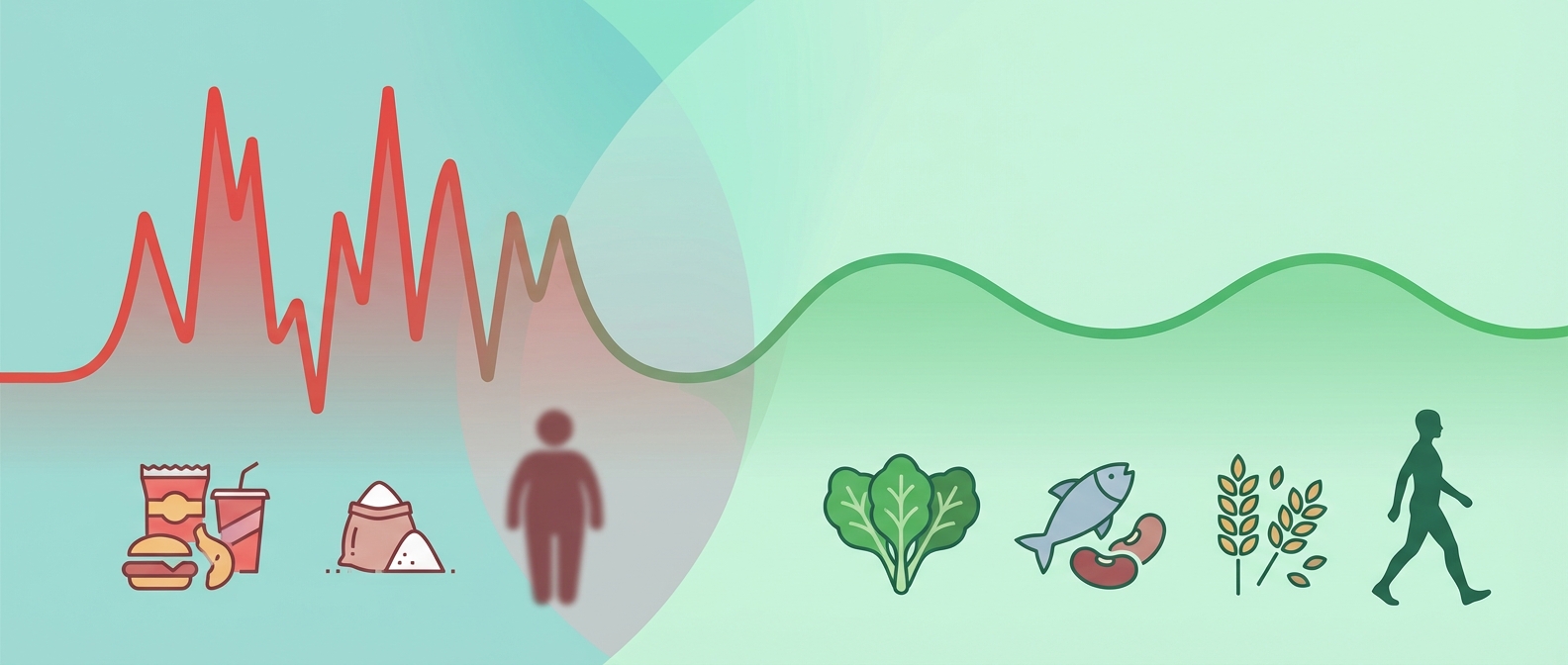
You know the feeling: after lunch, a wave of heavy fatigue hits. Your brain feels wrapped in cotton, concentration drops, and you reach for coffee or a candy bar. Two hours later – same thing all over again.
What most people don’t realize: That afternoon slump isn’t about sleep deprivation. It’s your blood sugar. And the best part: you can control it with a few simple strategies – no diet or restriction required.
What Happens During a Blood Sugar Spike?
When you eat, food is converted into glucose – the primary fuel for your brain and muscles. So far, so good. The problem starts when too much glucose floods your bloodstream at once.
The Spike-Crash Spiral
- The Spike: You eat something carb-heavy (white bread, pasta, candy). Your blood sugar shoots up within 15-30 minutes.
- The Insulin Response: Your body releases insulin to transport glucose from the blood into your cells.
- The Crash: Insulin often “overshoots” – your blood sugar drops below baseline. You feel tired, irritable, and hungry.
- The Craving: Your brain signals: “I need sugar!” – and the cycle starts over.
A meta-analysis (Mantantzis et al., 2019, published in Neuroscience & Biobehavioral Reviews) showed that carbohydrates have no positive effect on mood – instead, alertness drops significantly within 60 minutes of consumption. The often-cited “sugar rush” is a myth.
Why Stable Blood Sugar Matters for Everyone
Blood sugar fluctuations don’t just affect diabetics. Even in healthy people, sharp glucose spikes can have far-reaching consequences:
Energy & Performance
- Stable blood sugar = stable energy. No afternoon crashes, no brain fog.
- Studies show that even moderate glucose spikes measurably reduce cognitive performance for 1-2 hours.
Mood & Mental Health
- A scoping review (Avner et al., 2025, Sage Journals) found associations between glucose spikes and increased risk of depression, anxiety, mood swings, and irritability – even in people without diabetes.
- Stable blood sugar correlates with better emotional regulation.
Sleep Quality
- Evening blood sugar spikes can significantly disrupt sleep quality. High glucose levels before bed are associated with less deep sleep and more frequent awakenings.
Long-term Health
- Chronically elevated blood sugar spikes increase the risk of insulin resistance, type 2 diabetes, and cardiovascular disease.
- Visceral fat accumulation is promoted by frequent insulin spikes.
7 Science-Backed Strategies for Stable Energy
1. Eat in the Right Order
This is possibly the simplest and most effective hack: Eat vegetables and protein first, carbohydrates last.
A randomized controlled cross-over study showed that eating vegetables first significantly reduces the postprandial blood sugar spike – regardless of eating speed. The mechanism: fiber in vegetables slows gastric emptying and forms a protective “barrier” that slows rapid glucose absorption.
In practice:
- Start every meal with a salad or vegetables
- Then eat the protein (meat, fish, eggs, legumes)
- Carbohydrates (rice, pasta, bread) come last
- Effect: Up to 30-40% lower blood sugar rise with the identical meal
2. Move After Eating
A 10-15 minute walk after eating is one of the most powerful blood sugar regulators available.
Why it works:
- Your muscles consume glucose directly from the blood – without insulin
- Studies show a 20-30% reduction in blood sugar spikes from a post-meal walk
- Even 2-3 minutes of stair climbing or 10 minutes of slow walking is enough
Tip: Set a timer for 15 minutes after your meal. Walk around the block or take a short stroll in the office. This is more effective than any supplement.
3. Apple Cider Vinegar Before Meals
It sounds like a folk remedy, but the research is surprisingly solid. A randomized, controlled clinical trial showed that apple cider vinegar (ACV) significantly lowers post-meal blood sugar.
The mechanism:
- Acetic acid slows gastric emptying
- It inhibits certain digestive enzymes that break down starch
- Interestingly, the effect occurs even when vinegar isn’t taken directly with the meal
Dosing:
- 1-2 tablespoons of apple cider vinegar in a glass of water
- Drink 15-20 minutes before the meal
- Important: Always dilute (tooth enamel!) and avoid on an empty stomach if you have a sensitive digestive system
4. Use Fiber Strategically
Fiber is your body’s natural blood sugar stabilizer. It slows digestion and creates a gradual rather than explosive glucose rise.
Best fiber sources:
- Flaxseeds: 2 tablespoons contain 4g of fiber – mix into breakfast
- Chia seeds: Form a gel in the stomach that slows nutrient absorption
- Legumes: Lentils and beans have an extremely low glycemic index
- Green vegetables: Broccoli, spinach, kale – ideally with every meal
Target: 30-40g of fiber per day. Most people don’t even reach 20g.
5. Add Protein and Fat to Every Meal
Protein and healthy fats slow glucose absorption and provide long-lasting satiation.
Why it works:
- Protein stimulates GLP-1 and GIP – hormones that regulate insulin release
- Fat slows gastric emptying
- The combination of protein + fat + carbohydrates creates a significantly flatter blood sugar curve than carbohydrates alone
Practical examples:
- Instead of toast with jam → toast with avocado and egg
- Instead of fruit alone → fruit with nuts or yogurt
- Instead of plain pasta → pasta with salmon and olive oil
6. Optimize Your Timing
When you eat is almost as important as what you eat.
Key insights:
- Your body is most insulin-sensitive in the morning. The same meal causes a higher blood sugar spike in the evening than in the morning.
- Late eating (after 9 PM) leads to higher nighttime glucose levels and worse sleep.
- Regular meal times train your body to release insulin more efficiently.
For Intermittent Fasting / OMAD:
- If you eat only one meal per day, timing is especially important
- Ideally eat between 12-6 PM (highest insulin sensitivity)
- Eat large OMAD meals slowly and start with vegetables/protein
7. Control Sleep and Stress
Poor sleep and chronic stress are hidden blood sugar killers.
Sleep:
- Just one night of less than 6 hours of sleep reduces insulin sensitivity by up to 25%
- Sleep deprivation raises cortisol levels, which directly elevates blood sugar
- The combination of poor sleep + a carb-heavy breakfast is the perfect spike trap
Stress:
- Cortisol (the stress hormone) causes the liver to release stored glucose into the blood
- This means your blood sugar can rise without eating anything
- Chronic stress leads to chronically elevated blood sugar and insulin resistance
Countermeasures:
- Prioritize 7-9 hours of sleep
- Breathing exercises (e.g., 4-7-8 method) before stressful situations
- Regular exercise (especially Zone 2 training) improves insulin sensitivity
CGMs: The Game-Changer for Self-Optimizers
Continuous Glucose Monitors (CGMs) were reserved for diabetics until recently. Now, more and more health-conscious people use them to track blood sugar in real time.
What a CGM Shows You
- Which foods trigger spikes in your body specifically (it’s individual!)
- How your body responds to stress, exercise, and sleep
- Whether your strategies (meal order, movement) actually work
Key CGM Metrics
| Metric | Optimal | Acceptable |
|---|---|---|
| Fasting glucose | 70-90 mg/dL | 70-100 mg/dL |
| Postprandial (after eating) | < 120 mg/dL | < 140 mg/dL |
| Variability (CV) | < 20% | < 25% |
| Time in Range (70-140) | > 90% | > 80% |
Do I Need a CGM?
Yes, if:
- You want to understand how your body reacts to different foods
- You have chronic fatigue or brain fog
- You want to optimize performance (sports, work)
- You have a family history of diabetes
No, if:
- You want to try the strategies above first (they work without a CGM too)
- You’re prone to data overload and stress
- You’re on a fixed budget (CGMs cost $50-100/month)
Your Action Plan for Stable Energy
You don’t have to implement everything at once. Start with the easiest measures and build from there:
Week 1: The Basics
- Eat vegetables and protein before carbohydrates
- 10-minute walk after lunch
- No sweets on an empty stomach
Week 2: Optimization
- Test apple cider vinegar before your biggest meal
- Add more fiber (flaxseeds, chia, legumes)
- Always combine snacks with protein
Week 3: Fine-Tuning
- Optimize meal timing (no eating after 8 PM)
- Improve sleep hygiene (7+ hours)
- Integrate stress management (breathing exercises)
Bottom Line: Energy Isn’t Random
Most people accept energy crashes as normal. “That’s just how I am.” But the science is clear: Stable energy isn’t about genetics – it’s about habits.
With the right strategies – primarily meal ordering, post-meal movement, and adequate sleep – you can flatten your blood sugar curve and stay sharp all day long.
The afternoon slump? Doesn’t have to happen. The third cup of coffee? Unnecessary. The sugar cravings? They disappear on their own when your blood sugar stays stable.
Your body isn’t a mystery – it follows clear biochemical rules. And you can use them to your advantage.
Sources: Mantantzis et al. (2019), Neuroscience & Biobehavioral Reviews; Avner et al. (2025), Sage Journals; Ohio State University Medical Center; Abbott Nutrition Research. This article is for informational purposes and does not replace medical advice.