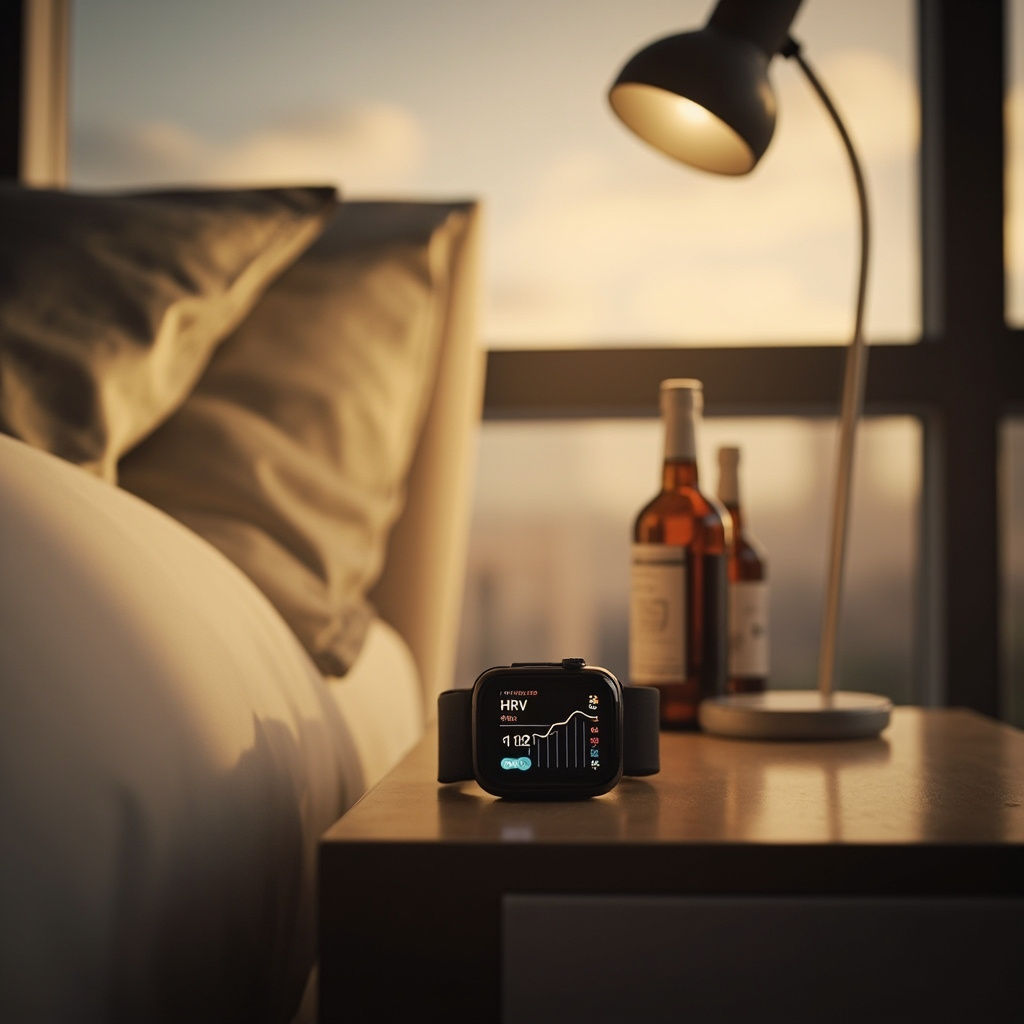
30 Days Without Alcohol: What Really Happens to Sleep, HRV, and Resting Heart Rate
“I only have one drink in the evening.” That’s exactly why this experiment is powerful. Moderate alcohol use often feels harmless, yet sleep and recovery data frequently tell a different story. A consistent 30-day break can produce clear shifts in sleep continuity, heart rate variability (HRV), resting heart rate, and next-day energy.
This is not about moralizing alcohol. It’s about measurement. If you care about health, performance, or resilience, a 30-day no-alcohol block is one of the cleanest self-experiments you can run.
In this guide, you’ll learn:
- how alcohol affects sleep architecture and autonomic recovery,
- what changes are realistic (and which claims are hype),
- how to run a robust 30-day protocol,
- and how to build a sustainable strategy afterward.
Fast Takeaways
- Alcohol may reduce sleep-onset latency, but often worsens sleep architecture and second-half sleep quality.
- Even low-to-moderate intake can suppress nighttime HRV and raise resting heart rate.
- Many people see more stable sleep and better readiness after 1–2 alcohol-free weeks.
- Most benefits are not “detox magic”—they come from better sleep continuity and lower autonomic strain.
- You only get meaningful conclusions with a baseline vs intervention approach.
Why Alcohol’s Sleep Effect Is Paradoxical
People often confuse “falling asleep faster” with “sleeping better.”
Alcohol can be sedating early in the night, but it also alters core systems that shape recovery:
- GABAergic sedation creates an initial calming effect.
- Glutamatergic rebound later in the night increases arousal risk.
- REM suppression in early sleep can be followed by REM rebound later.
- Sympathetic activation during metabolism can drive higher pulse and lower HRV.
- Thermoregulatory and hydration effects can fragment sleep.
The practical pattern is common: easier sleep onset, then less stable second-half sleep and worse morning recovery signals.
What the Evidence Actually Supports
The literature is strong enough for directional conclusions:
- Acute alcohol intake can alter sleep architecture and reduce restorative sleep quality.
- Field and wearable studies repeatedly show worse recovery markers on nights with alcohol.
- HRV is highly sensitive to alcohol exposure, often showing detectable suppression.
What evidence does not support:
- That everyone responds the same way,
- that one drink is always catastrophic,
- or that 30 days solves every sleep issue.
That’s why your personal trend matters more than population averages.
The 3 Core Metrics for a 30-Day Alcohol Break
Don’t drown in dashboards. Track three primary metrics plus two context markers.
1) HRV (Primary)
HRV reflects autonomic balance and stress adaptation.
How to track:
- Use consistent nighttime/morning measurement,
- evaluate 7-day moving averages,
- keep measurement conditions as stable as possible.
2) Resting Heart Rate (Primary)
Alcohol often shows up as a higher overnight or morning resting pulse.
How to track:
- Focus on trend direction,
- watch 3+ consecutive nights,
- interpret together with HRV.
3) Sleep Continuity (Primary)
Beyond sleep duration, monitor:
- wake after sleep onset,
- nighttime interruptions,
- subjective morning restoration.
Context Markers (Secondary)
- Morning energy (1–10)
- Perceived training/work readiness
When objective trends and subjective state align, confidence is high.
Realistic 30-Day Timeline
Days 1–3
- Habit friction is often social/behavioral, not physiological.
- Some people sleep worse briefly because sedative effects are gone.
- Avoid overreacting to short-term noise.
Days 4–10
- Overnight pulse spikes often become less frequent.
- HRV trend may begin stabilizing upward.
- Morning “fog without hangover” often improves.
Days 11–20
- Sleep continuity frequently improves.
- Wake timing becomes more predictable.
- Better tolerance of cognitive and training load.
Days 21–30
- Trends become robust enough for decision-making.
- You can classify alcohol as a large, medium, or minor lever for your system.
- This is where sustainable strategy beats all-or-nothing thinking.
A Clean Pulselyze Protocol (Practical)
A vague “drink less” approach creates weak data. Use a structured protocol.
Step 1: Build a 14-Day Baseline
Before the challenge, log:
- alcohol nights (amount + timing),
- bedtime/wake time,
- HRV, resting pulse, sleep continuity,
- stress level and late meals.
Step 2: 30 Days, Zero Alcohol
Simple rule: no exceptions. “Just one” often blurs the signal.
Step 3: Control Confounders
Keep these as stable as possible:
- caffeine dose and cutoff,
- training volume,
- late-night eating,
- sleep window consistency.
Step 4: Weekly Review (10 Minutes)
Each week compare to baseline:
- 7-day HRV,
- 7-day resting pulse,
- sleep fragmentation,
- subjective energy/readiness.
Step 5: Optional Re-Entry Test
After day 30, run one controlled evening (e.g., 1–2 drinks early) and observe next-night impact. This often creates the clearest long-term behavior insight.
Common Interpretation Mistakes
Mistake 1: Overweighting single-day values
One bad night is noise; trends are signal.
Mistake 2: Isolating alcohol from context
Late meals, stress, illness onset, and heat can also depress recovery.
Mistake 3: Equating quick sleep onset with good sleep
Sleep quality is built across the whole night, not just the first 20 minutes.
Mistake 4: Tracking too many metrics
More data can reduce clarity if your decision framework is weak.
Mistake 5: Chasing perfection
Consistency beats perfect protocol purity.
If Going Alcohol-Free Feels Hard
This is mostly a behavior-design challenge. Use implementation tactics:
- If-then planning: “If dinner out, then alcohol-free beer + water first.”
- Increase friction: Keep no alcohol at home.
- Replace reward loops: tea ritual, short walk, breathing sequence.
- Script your social response: “I’m running a 30-day sleep/HRV experiment.”
- Visual progress: chain calendar or daily tracker check.
If you experience strong cravings, loss of control, or withdrawal symptoms, seek medical support.
Performance Angle: Why This Is a High-Leverage Move
Athletes and high-output professionals often expect supplements to move recovery. In practice, alcohol reduction frequently outperforms expensive interventions.
Common real-world effects:
- better morning readiness,
- more consistent training quality,
- lower perceived exertion at same workload,
- improved weekly predictability.
Not always dramatic—but often reliably positive.
After 30 Days: Sustainable Strategy Options
The right question is rarely “never again?” It’s “what pattern supports my goals?”
Option A: 80/20 structure
- 80% alcohol-free,
- 20% intentional and planned.
Option B: Event-only model
Only for meaningful occasions; no routine weekday drinking.
Option C: Performance blocks
Strictly alcohol-free during training cycles or high-demand project windows.
Keep it data-informed. You now have your own response profile.
FAQ: Most Common Practical Questions
“Is non-alcoholic beer allowed?”
Yes—if it is truly alcohol-free. For the cleanest signal, choose 0.0% products. That avoids ambiguity around residual alcohol and keeps your protocol strict.
“What about one glass at a business dinner?”
If measurement quality matters, skip it. If you intentionally deviate, log amount + timing and evaluate next-night impact. You still keep the learning value if you document it.
“When should I expect changes?”
Many people notice directional improvements between days 4 and 14. If baseline stress is high or sleep is irregular, effects can take longer. Trust 7–14 day trends, not the first few nights.
“Do beer, wine, and spirits differ?”
They can, but in real life, outcomes are often driven more by total alcohol dose, timing, and context (late meals, short sleep windows) than beverage type.
“Can I keep training normally during the challenge?”
Yes. Try to keep training load reasonably stable so your before/after comparison remains interpretable.
Bonus: A 5-Minute Evening Tracking Protocol
This simple protocol improves signal quality dramatically. Each evening, log:
- time of last meal,
- caffeine after 2 PM (yes/no),
- stress level (1–10),
- training load (light/moderate/hard),
- screen exposure in the final hour before bed (yes/no).
Each morning, add:
- sleep quality (1–10),
- energy (1–10),
- mental clarity (1–10).
This lets you separate alcohol effects from confounders and make better long-term decisions.
Final Takeaway: Data Over Dogma
A 30-day alcohol break is one of the most useful sleep and recovery experiments available.
Not because it’s trendy. Because it gives you clear personal signal:
- How much does your HRV change?
- How strongly does resting pulse respond?
- What happens to your sleep continuity?
Answer those questions once, properly, and your future decisions become dramatically easier.
If you already use wearables, start with baseline tracking today.
Selected References
- Ebrahim IO et al. Alcohol and sleep I: Effects on normal sleep. Alcoholism: Clinical and Experimental Research.
- Roehrs T, Roth T. Sleep, sleepiness, sleep disorders and alcohol use and abuse. Sleep Medicine Reviews.
- Thakkar MM et al. Alcohol disruption of sleep homeostasis and circadian rhythm. Sleep Medicine Clinics.
- Chan M et al. Alcohol use and heart rate variability: systematic review evidence.
- Clinical sleep medicine literature on alcohol-related sleep fragmentation and REM effects.
(Note: Wearables are not equivalent to polysomnography but are excellent for personal trend tracking.)